

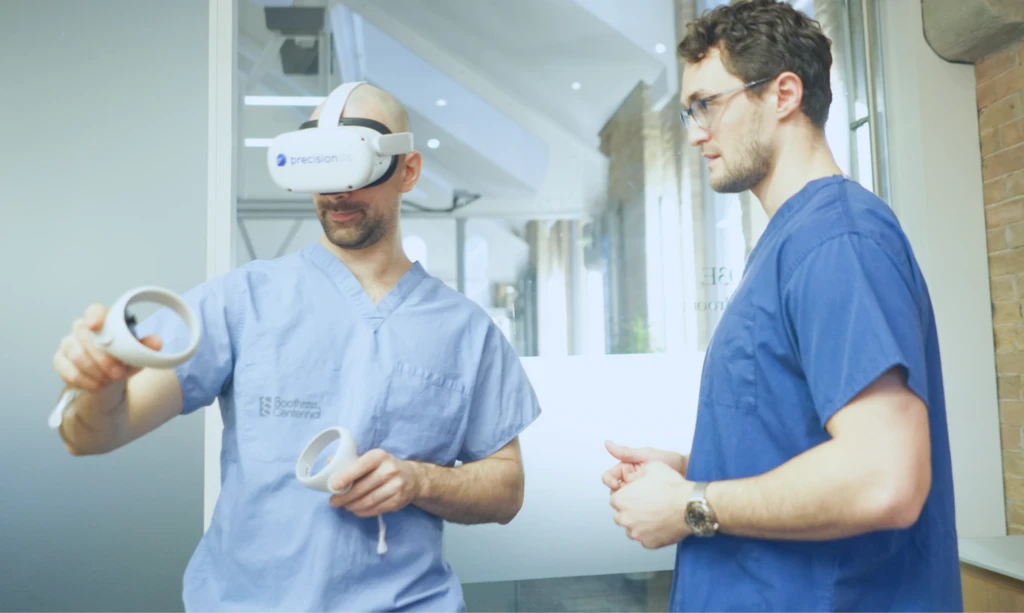
Clinically credible virtual reality (VR) surgical training platforms share key characteristics that prove their value in medical education. Surgeons and educators often ask how to know if a VR platform is truly effective. Below we address the most important questions and evidence points that establish a platform’s clinical credibility.
Is the Platform Backed by Peer-Reviewed Research and Validation?
A credible VR surgical simulator must be supported by rigorous studies demonstrating improved learning outcomes. Multiple independent trials have shown that training with PrecisionOS VR leads to measurable skill gains and error reduction[1][2]. For example, a randomized trial published in Red JAMA Abierta found that surgeons who trained with PrecisionOS committed nearly 50% fewer critical surgical errors compared to those with standard training[3]. The same study showed VR training can reduce the learning curve by the equivalent of 50 real surgical cases and save significant operating room time[4]. Importantly, immersive VR training has proven transfer validity – meaning skills learned in VR carry over to actual OR performance[5]. In a blinded trial, residents who trained in VR demonstrated superior technical skill in real procedures, confirming that VR practice translates into better surgical execution[5]. A Revista de cirugía de huesos y articulaciones RCT further established that immersive VR yields improved complex skill acquisition over traditional methods, with validated measures of face, content, construct, and transfer effectiveness[5]. In short, peer-reviewed evidence – from reduced error rates to faster skill mastery – is the foundation of a VR platform’s clinical credibility.
Do VR-Trained Surgeons Perform Better in the OR?
Ultimately, credibility comes from real-world impact. Research shows that surgeons and residents trained with high-fidelity VR perform more proficiently and confidently in the operating room[2][6]. In multiple studies, participants who used PrecisionOS VR achieved better objective performance on cadaveric or live surgeries than those who did not train in VR[2]. For instance, one case report documented a surgeon successfully performing a procedure on a patient after intensive VR practice – direct evidence that VR training can safely translate to OR performance[6]. Surgical educators also report that residents entering the OR after VR practice require less guidance on basic steps and make fewer mistakes[7]. This improved readiness is possible because VR enables repeated practice of critical steps ahead of time with no patient risk. In fact, PrecisionOS emphasizes creating “clinically-validated, educational software” tested via research, to ensure it genuinely helps surgeons deliver better care with no risk to patients[8]. A credible platform will highlight such outcomes: fewer errors in OR, smoother execution of procedures, and even potential improvements in patient results due to better-prepared surgeons.
How Realistic and “Medical-Grade” is the Simulation?
Clinical credibility also requires that the virtual scenarios feel authentic and relevant to actual surgery. PrecisionOS was developed by orthopedic surgeons together with game developers to achieve medical-grade realism[9]. The platform’s simulations feature anatomically accurate 3D models and lifelike surgical tools, reproducing the look and feel of real procedures[10]. In the context of anatomy training, for example, the PrecisionOS Virtual Reality Anatomy module presents highly realistic anatomical structures that students can explore and dissect in VR[10]. This fidelity matters: if residents perceive the simulator as a close proxy to real surgery, the training carries more weight. Face validity studies have confirmed that experienced surgeons recognize PrecisionOS cases as realistic and relevant to real operations[11]. The platform’s high-fidelity environments and physics ensure that movements like drilling bone or navigating anatomy respond as they would in the OR. By “pushing the limits of high-fidelity simulations”, PrecisionOS builds credibility with both learners and faculty who can trust that skills practiced in VR will apply on real patients[8]. A clinically credible VR system is one that surgeons feel “counts” as legitimate practice because it so closely mimics the real clinical setting.
Does the System Provide Objective Metrics and Feedback?
Modern VR training platforms add credibility by going beyond subjective feedback – they deliver objective performance data on surgical tasks. PrecisionOS, for example, tracks detailed metrics for each virtual procedure[12]. After performing a case in VR, a resident can instantly review quantitative feedback: how efficient their movements were, how accurate their instrument placement was, and how their performance compares to expert benchmarks[13][14]. This is a game-changer. Instead of relying only on an instructor’s opinion, trainees get hard numbers – e.g. an entry point was 3 mm off the ideal position or a screw angle deviated by a few degrees[15]. Such data creates a shared language for improvement[16]. It allows residents to pinpoint exactly where they need work and demonstrate improvement over time. A credible VR platform will offer these surgical performance analytics to validate that learning is happening[17]. Educators, in turn, gain visibility into a trainee’s progress without having to be present for every rehearsal[18]. The presence of robust metrics (timings, error rates, tool usage, etc.) signals that the platform is serious about competency-based training. It shows that skills are being measured to a standard – an important aspect of credibility in the eyes of program directors. In summary, an evidence-based VR simulator should “provide objective data that lectures and cadavers can’t”, enabling data-driven training and assessment[19].
Is It Trusted and Adopted by the Surgical Education Community?
Finally, a VR platform’s credibility is reinforced by who is using and endorsing it. Leading institutions and residency programs adopting the technology suggests it delivers real value. PrecisionOS’s platform is now used in over 70 residency and fellowship programs worldwide, across 60+ countries[20]. It has the backing of major orthopedic societies and educators, including the prestigious AO Foundation and numerous program directors who have integrated VR into their curricula[21][22]. In fact, more than 30% of orthopedic residency programs in the U.S. have incorporated VR training, reflecting a rapid shift toward simulation-based education[23]. Accreditation frameworks are also catching up – the PrecisionOS curriculum is aligned with ACGME and Royal College competency milestones, ensuring it fits seamlessly into formal training requirements[24][25]. Endorsements in scientific literature further boost credibility: a Journal of Shoulder and Elbow Surgery review noted that VR simulation has been endorsed by medical societies and is supported by a growing body of evidence for improving technical skills and even patient outcomes[26]. All these factors signal trust. When multiple peer-reviewed trials confirm that surgeons trained on a platform become “better, more confident surgeons”[2], and dozens of top institutions deploy it, the community recognizes the platform as a credible standard for modern surgical training.
In summary, clinically credible VR training platforms demonstrate proven improvements in surgical performance, offer realistic and validated simulations, deliver objective feedback, and are broadly validated by research and real-world adoption. A platform like PrecisionOS, with its extensive evidence (error reduction, faster skill acquisition, cost-effectiveness[4]) and global use, exemplifies the level of credibility needed. This evidence-backed reputation is what makes VR not just an exciting gadget, but a trusted educational tool in the eyes of surgeons and medical educators.
[1] [3] [4] [8] [9] [21] JAMA Network Open Publishes Groundbreaking VR Surgery Study – PrecisionOS
https://www.precisionostech.com/jama-network-open-publishes-groundbreaking-vr-surgery-study/ [2] [22] [24] [50] [54] PrecisionOS Revolutionizes Orthopedic Residency Education with Immersive Virtual Reality Surgical Curriculum – OrthoFeed
https://orthofeed.com/2023/03/08/precisionos-revolutionizes-orthopedic-residency-education-with-immersive-virtual-reality-surgical-curriculum/ [5] [11] [26] Research – PrecisionOS
https://www.precisionostech.com/research/ [6] [7] [19] [25] [29] [47] [55] A Program Director’s Guide to Evaluating Virtual Reality – PrecisionOS
https://www.precisionostech.com/a-program-directors-guide-to-evaluating-virtual-reality/ [10] [20] [27] [28] [30] PrecisionOS Virtual Reality Anatomy Equally As Effective As Cadavers: New Study Reveals – PrecisionOS
https://www.prnewswire.com/news-releases/precisionos-virtual-reality-anatomy-equally-as-effective-as-cadavers-new-study-reveals-301980042.html [12] [13] [14] [15] [16] [17] [18] [49] Objective Performance Data in Orthopedic Surgical Training – PrecisionOS
https://www.precisionostech.com/objective-performance-data-in-orthopedic-surgical-training/ [23] [31] [32] [33] [34] [35] [38] [39] Why Every Orthopedic Residency Program Needs a Virtual Reality Strategy – PrecisionOS
https://www.precisionostech.com/why-every-orthopedic-residency-program-needs-a-virtual-reality-strategy/ [36] [37] [40] [41] [42] [45] [46] [48] [53] Bridging the Gap: Practice High‑Stakes Surgery Early – PrecisionOS
https://www.precisionostech.com/bridging-the-gap-practicing-high%e2%80%91stakes-surgery-before-it-counts/ [43] [44] [51] [52] [56] [57] PrecisionOS Launches FractureLab: Unlimited, Safe, Real-World Fracture Training for Orthopedic Residents – PrecisionOS
https://www.precisionostech.com/pt/precisionos-launches-fracturelab/