

Supercharging surgical learning with behavioural science, learning theory, and an AI-enhanced simulation loop
Surgical training has a familiar problem: learners are motivated, but the system rarely makes it easy to translate motivation into the right practice, at the right time, with the right feedback, and the right next step.
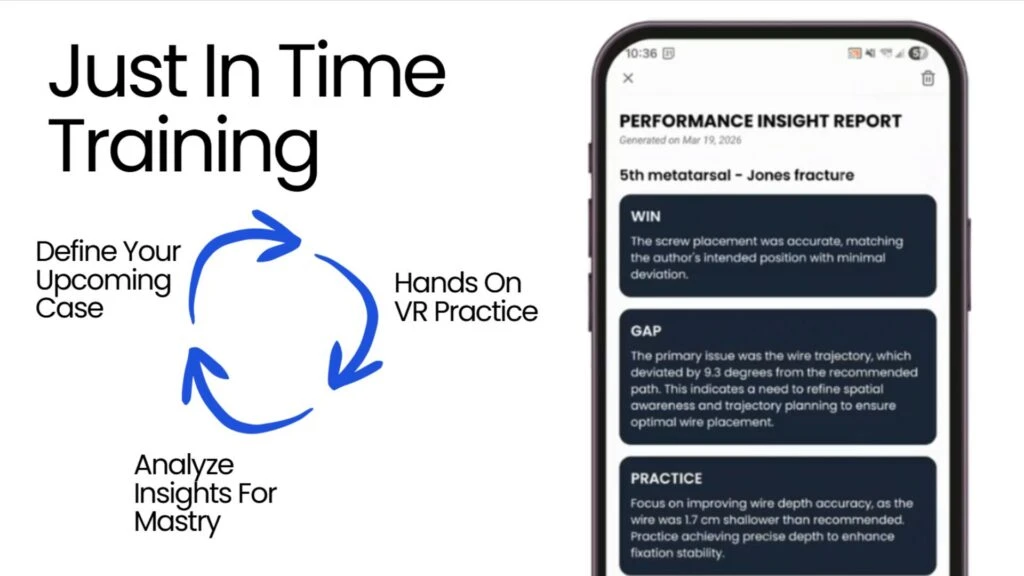
In our April release, we have intentionally redesigned PrecisionOS around learning science to address this specific issue. We have built an AI-enhanced simulation training loop that:
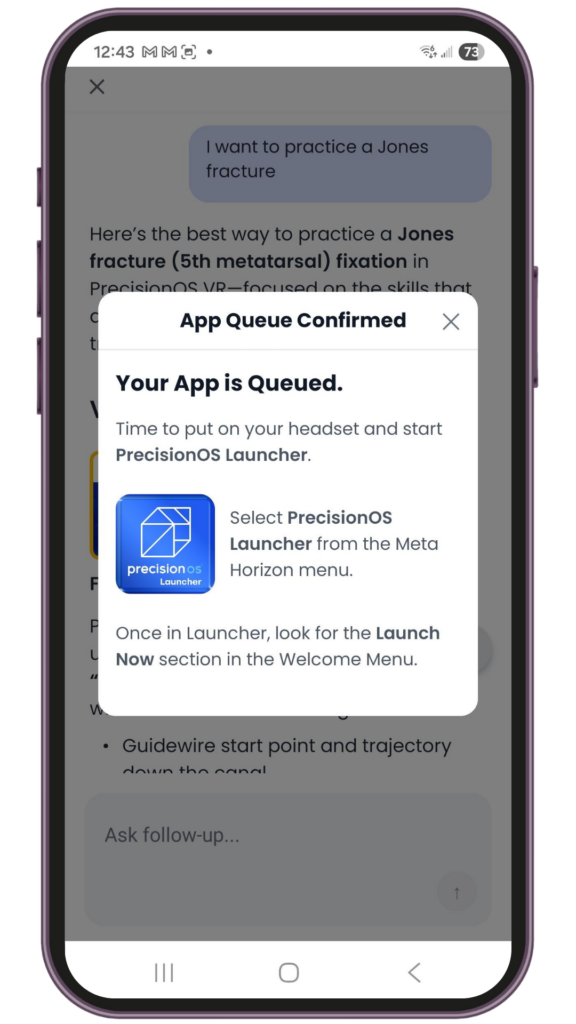
- recommends just-in-time VR practice based on a learner’s immediate case schedule,
- accelerates skill acquisition through immersive VR simulation, and
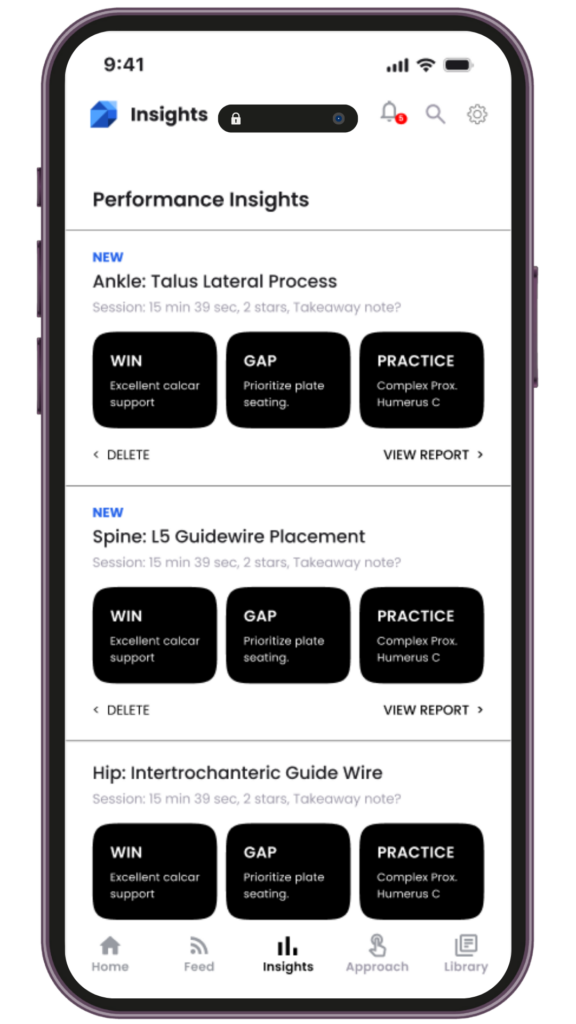
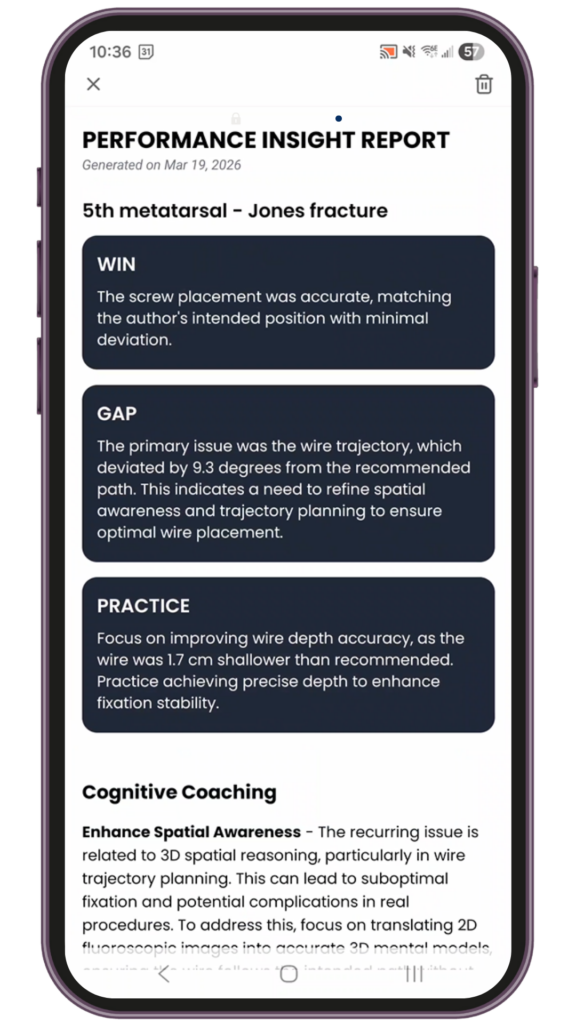
- delivers immediate, personalized feedback after each session, as training insights, to their mobile app, reinforcing progress and
- helping them know exactly where to return in VR for continued skills practice.
This is not “more content.” It is a tighter system for turning practice into measurable improvement.
The goal is simple: make it easy to go from:
- practice → feedback → recommendation → next session
without losing momentum.
How it works: The learning loop
From intention to improvement (and back again)
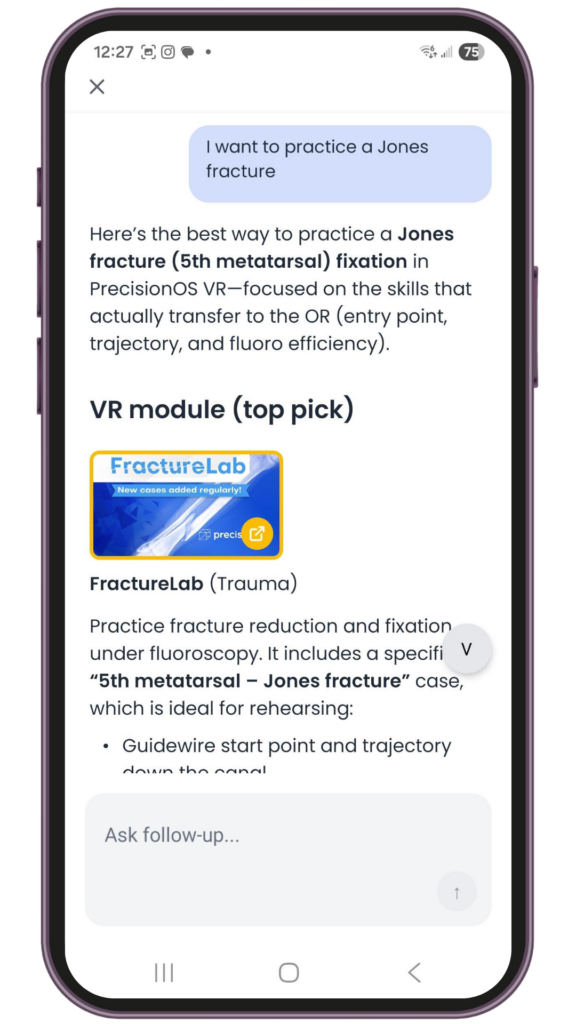
- A learner tells our AI (in our mobile app) what case they need to prepare for (case intent and learning goal).
- We provide just-in-time recommendations (what to watch on video, what VR app to practice, or what session to repeat).
- The learner practices in realidad virtual, where immersive experiences support faster learning transfer.
- The system generates immediate, personalized feedback from real performance, the most actionable type of feedback.
- Insights are delivered to mobile with notifications and continuity, providing instant clarity about what to do next to improve.

The science behind it.
1) Just-in-time training: Start with intent, not browsing
Behavioural science is clear that “choice overload” and high friction kill follow-through. In surgical training, it is easy to lose a motivated learner at the exact moment they want to prepare for a case, because time and other priorities get in the way.
That is why our new mobile Home experience is being designed around a more direct interaction: the user can tell PrecisionOS what they need to practice, learn, or prepare for, and the system responds with recommendations that are relevant to that stated goal.
This is where conversational design becomes a learning accelerant. Instead of a static library experience, we are moving toward an interaction pattern that supports:
- A clear prompt (“What case do you need to prepare for?”),
- A relevant recommendation,
- A follow-up that keeps the learner moving toward action.
2) Why immersion matters: VR speeds learning because it looks like the job but cuts out the noise.
Learning theory emphasizes that skills transfer better when practice resembles the performance environment. Immersive simulation helps because it is:
- Embodied (motor and spatial execution, not just observation),
- Contextual (anatomy, and sequencing the real task),
- Repeatable (learners can practice the hardest parts over and over). Plus,
- De-noises (promotes flow as distraction is removed).
In this release, we are also expanding realism and case coverage to support more meaningful reps, including new supine elbow and knee positions and improved surgical tools.
Immersion gives the learner “real” practice conditions. But immersion alone is not enough. The learning gains come when practice is paired with immediate, actionable feedback.
3) Immediate feedback: turning reps into informed reps
Practice without feedback is just repetition.
With this release, FractureLab is moving toward surgical-grade feedback: the learner can see alignment and deviation relative to the ideal, and get clinically relevant guidance precise enough to turn a “miss” into an immediate learning moment.
This is core learning theory: fast, specific feedback helps learners update their mental model while the attempt is still fresh.
But there is another major risk we design around: cognitive overload. Even high-quality data fails if it is delivered in a way that is too dense to use.
4) “Brevity-first UI”: a report designed for learning, not scorekeeping
One of the easiest ways to break learning is to bury the learner in telemetry. That is why our Performance Insights Report is built around a core design principle: “Brevity-First UI”.
The report is structured for learners’ bandwidth.
“The Quick Glance” (executive summary)
Goal: an instant assessment for a busy resident or faculty member.
Content: a strict three-sentence summary:
- One win: what the learner did well
- One gap: the most urgent clinical deficit
- One opportunity: a specific practice area for focused improvement
This is intentionally behaviour-shaping. It rewards progress, identifies the single most important correction, and gives the learner a concrete next action.
“The Deep-Dive” (coaching tip, not raw metrics)
Goal: teach judgment, not just mechanics.
Design note: designed to avoid raw data, and the UI treats it as an “insight” or “coaching tip,” not a scoreboard.
Instead of “Angle off by 12°,” the feedback should sound like an attending coach:
“You are prioritizing plate seating over screw trajectory. Shift your mental model to prioritize Calcar support.”
This is learning science: concept-level coaching is how technical skill becomes clinical judgment.
5) Personalization that makes feedback specific “to me”
We also design the report to carry context so the learner can interpret feedback as relevant and tailored to their,
- Training level
- Rotation
- Accreditation framework, and ****
- Individual session performance
So we can recommend the next case based on their needs. All designed to help them with “what they need”, “when they need it”.
This is the “supercharging” effect: personalization is not a novelty. It is what turns feedback into fuel for their next practice.
The takeaway: PrecisionOS is a supercharged learning ecosystem
If you define PrecisionOS as a VR, you undersell it.
With this release, PrecisionOS is a data and coaching ecosystem that leverages VR simulation for personalized learning. Plus, it’s only getting smarter as we leverage AI to continue to enhance personalized learning, feedback, and just-in-time training, accelerating objective surgical skills acquisition.
Sobre PrecisionOS
PrecisionOS is a leader in virtual reality-enabled surgical education. Trusted by health systems, academic medical centers and professional societies worldwide, the company delivers immersive, scalable training designed by surgeons for the next generation of healthcare professionals.
Contacto con los medios:
info@precisionostech.com
www.precisionostech.com