Try the PrecisionOS Mobile App for FREE.  Descargar ahora

Educación del cirujano: la realidad del futuro es virtual

Article Summary

enero 8, 2019

In This Article:

Preoperative Planning

Educación del cirujano

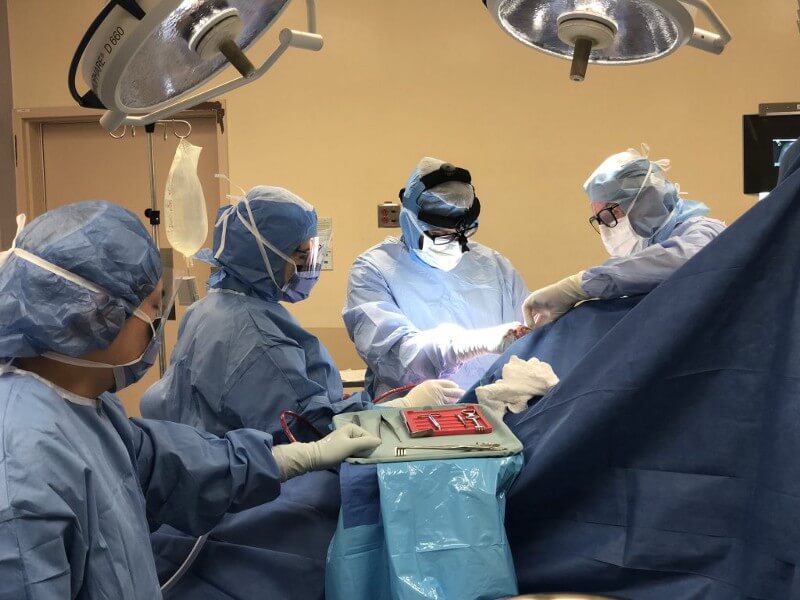
Formación de cirujanos is a significant undertaking for both the learner and the teacher. To first do no harm, trainees spend countless hours learning to become competent and safe. The means to this end however has significant limitations. The cliché of see one, do one, teach one grossly oversimplifies the acquisition of a surgeon’s skill, is actually unethical and requires elaboration.

Horas de trabajo de los residentes: ¿estamos buscando las métricas adecuadas?

Entrenamiento de residencia can be divided into two separate skills. Book smarts and technical ability. These are not mutually exclusive and require exposure to lectures and the operating room. Although residency work hours have changed in North America and Europe, the challenge among educators has always been the same. How to increase a trainee’s exposición quirúrgica, ¿les permite ser independientes en el quirófano y desarrollar su confianza sin comprometer la atención al paciente?

Ver uno, hacer uno, enseñar a uno minimiza groseramente el arte de aprender cirugía. La cirugía, como cualquier actividad, es una combinación de expresión física y mental. El uso de cadáveres y huesos de sierra, aunque limitado, es el modelo exacto que requiere una evaluación crítica. Cuánta preparación mental requiere el uso de un hueso de sierra para aprender a operar. ¿Es similar a usar un palo de escoba para practicar su swing de golf? Entonces, la pregunta sigue siendo, ¿cómo se puede convertir en un experto en nuestro modelo de formación actual?

How should we learn in 2018? We can’t all be experts, or can we?

Cirujanos expertos

Una característica distintiva de un cirujano experto incluye una capacidad refinada de toma de decisiones clínicas con un nivel aprendido de habilidad técnica. Su experiencia se desarrolló a través del volumen de casos y las lecciones aprendidas de esos procedimientos. Cada error se convirtió en un punto crítico de aprendizaje que los hizo mejores, más experimentados y, finalmente, expertos. Este modo de aprendizaje es fundamental para el trabajo del psicólogo Anders Ericsson. La mejora del desempeño hacia la experiencia se logra mediante una autoevaluación diligente y la repetición, lo que se conoce como “práctica deliberada”. Entonces, ¿cómo se convierte el cirujano en formación en experto técnico? Aumentar el volumen es un enfoque bien documentado para mejorar el rendimiento. Todas las partes interesadas están interesadas en abordar este problema de frente a través de la oferta de cursos. La intención es minimizar las complicaciones. Pero, ¿cómo se evitan las complicaciones si no se comprende qué debe hacer para provocarlas? ¿Es un gesto de la mano, un retractor fuera de lugar? Cometer errores cuando se asocia con la reflexión, la deliberación y luego seguido de la “repetición” ofrece los medios más eficaces para mejorar el desempeño técnico. Pero, ¿dónde o con quién practicaremos estas habilidades? ¿Cómo debemos aprender en 2018? No todos podemos ser expertos, ¿o sí?

La realidad virtual puede proporcionar un medio por el cual los cirujanos y los aprendices pueden mejorar su habilidad quirúrgica.

La práctica "deliberada" hace la perfección

Con el inicio de realidad virtual (VR) y la introducción de tecnologías inmersivas en la medicina, existe un entusiasmo increíble por la posibilidad de responder a las preguntas anteriores. Si realizamos una cirugía virtual, quizás todos seamos expertos. La realidad virtual puede proporcionar un medio por el cual los cirujanos y los aprendices pueden mejorar su habilidad quirúrgica, tomar decisiones y darse cuenta de su resultado mientras realizan un volumen significativo de casos virtuales. Aunque se ha generado un entusiasmo considerable por la realidad virtual, se debe proceder con precaución. Para evitar una introducción equivocada de esta valiosa tecnología, las partes interesadas deben evaluar esta herramienta con un enfoque reflexivo y considerado para brindar el mayor beneficio a nuestros usuarios y, en última instancia, a nuestros pacientes. Existe una oportunidad real de "doblar" la curva de experiencia para todo tipo de procedimientos. Para permitir errores virtuales, permita la provocación y la repetición. A mayor escala, el impacto en el sistema de atención de la salud y el potencial para brindar atención basada en valores pueden estar al alcance. Con un enfoque centrado en el paciente, los cirujanos pueden mejorar realmente los resultados si se implementa una introducción reflexiva y cuidadosamente considerada de esta poderosa tecnología. Centrarse simplemente en la parte "hacer una" del aprendizaje, sería una infrautilización catastrófica de esta tecnología que potencialmente "cambia el juego". Un enfoque consciente, basado en evidencia, verdaderamente validado y considerado será importante para todas las partes interesadas en mejorar nuestra situación actual.

La cirugía, como cualquier actividad, es una combinación de expresión física y mental.

Aprende de tus errores

El Dalai Lama nos recuerda que el momento de mayor ganancia en términos de sabiduría y fuerza interior es a menudo el de mayor dificultad. Desafiar a nuestros usuarios en la realidad virtual, formular un pensamiento, tomar una decisión y darse cuenta del resultado de esa decisión proporciona el mayor impacto no solo para los aprendices quirúrgicos, sino también para la adquisición de habilidades en cualquier dominio. Puede ser que estemos en una era de tecnología inmersiva que proporciona un medio similar al quirófano. El potencial para brindar al alumno la oportunidad de aprender de sus errores, objetivar su desempeño y minimizar el daño al paciente puede estar más cerca de lo que pensamos.

Dr. Danny P. Goel es el CEO y cofundador de Precision OS Technology y es profesor asociado clínico en el Departamento de Cirugía Ortopédica de la UBC

Acerca de la tecnología Precision OS

Precision OS Technology es una empresa de software posicionada para impactar positivamente la cirugía ortopédica con sus plataformas de software de realidad virtual de alta fidelidad. Nuestro enfoque en los elementos críticos de la cirugía, la háptica y la retroalimentación métrica proporciona una experiencia educativa incomparable. Además, nuestro herramienta de planificación preoperatoria elimina el ensayo y error asociado con el cuidado de las fracturas a través de una interacción inmersiva con las imágenes del paciente.

Para obtener más información sobre la tecnología Precision OS, visite nuestro sitio web www.precisionostech.com/o envíenos un correo electrónico a info@precisionostech.com
Related Insights

Build Confidence For The OR, Now

Take your surgical preparedness to the next level with our immersive training ecosystem. Looking to scale your program? Request more info for your institution here.

Sobre PrecisionOS

PrecisionOS is a leader in virtual reality-enabled surgical education. Trusted by top academic medical centers, health systems, and professional societies worldwide, the company delivers an immersive, scalable training ecosystem designed by surgeons for residents and the next generation of healthcare professionals. By combining high-fidelity VR cadaver labs with on-the-go access via the Approaches mobile module and AI-driven performance reporting, PrecisionOS ensures surgeons are ready for the OR, today.

Preguntas frecuentes

Is there a step-by-step "Quick Start" guide for residents?

Yes—The Onboarding Course is your fastest path to proficiency. It walks you through account syncing, procedure selection, and your first virtual rehearsal step-by-step, ensuring you are “OR Ready” before you pick up the controllers.

Action: Follow the guided video path to standardize your learning experience.

Yes. PrecisionOS is compatible with Meta Quest 3, and 3s. If you already own a headset, you simply need to download the PrecisionOS Launcher from the App Store and sign in with your institution email and membership credentials.

Action: Download the launcher and log in.

Your Individual Membership is a month-to-month subscription ($99/mo) designed for residents who want 24/7 access to surgical rehearsal without a long-term contract.  Reach out for information about an institutional membership.

Action: Your card is billed every 30 days from the date of signup.

Hospital networks will often require a MAC address for device white-listing. You can find this in your Meta Quest headset settings under About > MAC Address.

Action: Reach out to provide your IT department with the MAC address found in your headset settings.

Both the headset firmware and the PrecisionOS app must be up to date to prevent technical glitches. Go to Settings > Software Update on your Quest and check the Launcher for app updates.

Action: Enable “Auto-updates” in your headset settings.

About The Author

Imagen de Danny P. Goel, MD

Danny P. Goel, médico

Is the CEO of PrecisionOS and is a practicing surgeon and surgical educator. Dr. Goel currently practices in the Vancouver, B.C. area and also serves on the University of British Columbia’s Faculty of Medicine in the Department of Orthopedic Surgery.

He received his medical degree from the University of Manitoba, pursued his residency training in orthopedic surgery at the University of Calgary, and completed fellowship training in shoulder surgery at the University of Western Ontario and Harvard University.

Goel has co-authored more than 30 publications, and is widely sought as a presenter on surgical techniques.

21 Months of Automated VR Data

MAJOR ACADEMIC ORTHOPAEDIC RESIDENCY PROGRAM

How self-directed VR practice fills the seams of the clinical day and produces measurable learning trajectories—completely automatically.

Executive Summary:

Over a 21-month period, 30 orthopaedic residents integrated immersive VR into their training curriculum. With a simple, weekly requirement for residents to practice in headset, the platform seamlessly captured over 88,000 structured data points across 2,566 practice sessions. The resulting data proved that when residents have access to high-fidelity, frictionless simulation and are motivated, they will hone their skills and demonstrate clear performance improvements.

Frictionless Adoption: Practice doesn't compete with clinical time. The data revealed that 45% of all sessions happened organically during lunch breaks or on weekends.

Comprehensive Coverage: Usage wasn't limited to a single subspecialty. Residents attempted 61 distinct cases across 27 procedure modules, proving active engagement from Foundations & Anatomy to Complex Trauma.

Measurable Improvement: The platform didn't just track usage; it tracked skill acquisition. Across 288 scored playthroughs, longitudinal data showed a clear performance signal, with residents demonstrating an average positive learning delta of +0.36 over time.

download from the app store

Own Your Progress.

Download the PrecisionOS mobile app to access Delphi’s insight reports and turn every VR session into a springboard for future success.

Step #1

State Your Intent

Tell Delphi, your AI Attending Mentor, what you are looking to practice.

Step #2

Get Practice Recommendations

Based on your request, Delphi will suggest personalized VR apps and Video training.

Step #3

Queue Apps In VR

Tap Add to Queue and the VR app will be waiting for you in headset.

Step #4

Learn From Experts

Access the video library for expert-led Virtual Grand Rounds and discover surgical pearls from industry leaders and device experts.

Step #4

Practice With A Plan

Go through the recommended VR apps to gain the skills and repetition needed for success. 

Step #5

Review Performance Insights

After your VR session, review your personalized performance insight on your phone to maximine your OR success. 

Smiling businessman in blue suit and tie against gray background.

Dr. Andrew Maeso

Orthopedic resident

From Uncertainty to Execution

“You already have a plan, now you’re just executing it.”

The Story: Bridging the "Intern Gap"

Dr. Andrew Maeso recognizes the steep reality of residency: “As an intern, you are thrown into the fire.” For him, the hurdle wasn’t just the surgery—it was the invisible mechanics (positioning, X-ray angles, and workflow) that move too fast to learn in a high-pressure OR.

The Solution: Access Over Policy

By bringing the PrecisionOS ecosystem home, Dr. Maeso replaced passive YouTube watching with active mental rehearsal. This allowed him to arrive in the OR with the “steps” already hard-coded into his muscle memory.

The Game Changer: Personal headsets issued for at-home, 24/7 training.

Clinical Focus: Mastery of Antegrade Femoral Nails and Shoulder Arthroscopy.

Program Growth: Experience led to secured funding for all incoming residents.

Smiling man wearing glasses and checkered shirt in an office setting.

Roberto Oliveira

Founder

Over his 25 years in the gaming industry, Roberto Oliveira has been known for bringing stunning realism and high fidelity to interactive experiences.

He combines an art director’s artistic vision with solid business leadership, including experience in building art teams, creative team management, project planning, project management and business development.

Over the years, his talents have been showcased in projects for major publishers including Sony, Activision, Disney and Electronic Arts.

Business professional wearing glasses and a suit in an office setting.

Dr. Ryan Lohre

MGH Staff Surgeon

From Resident to MGH Staff Surgeon

“Prepare like it matters. Because in the OR—it does.”

The Story: The Currency of Trust

Dr. Ryan Lohre’s trajectory changed during a complex pediatric case that had already seen two failed attempts by tenured surgeons. While textbooks offered the theory, Dr. Lohre used VR to master the 3D spatial intelligence required to build a mental model of the deformity and navigate C-arm imagery in real-time.

The Solution: The 18-Minute Sandbox

The night before surgery, Dr. Lohre rehearsed the procedure four times in VR from his own home. This high-fidelity rehearsal allowed him to arrive in the OR functioning at 80-90% proficiency, compared to the typical 10-20% for a resident facing a new, complex procedure.

The Game Changer: 18 minutes of at-home VR prep for a complex pediatric case.

Clinical Focus: Spatial intelligence for C-arm interpretation and screw trajectory.

Program Growth: Transitioned from trainee to Staff Surgeon at Mass General.

Dental professional in white coat with PrecisionOS logo.

Dr. Barry McDonough

Program Director

Teaching with Surgical Efficiency

“I let the junior resident do more than ever before—and still finished on time.”

The Story: Reclaiming the OR

While at West Virginia University (WVU), Dr. Barry McDonough faced a universal challenge: balancing resident education with strict OR efficiency. By the time residents step into the OR, foundational skills like camera handling and triangulation should be second nature—not a distraction that slows down the case.

The Solution: Independent Preparation

Residents were assigned just 10 minutes of asynchronous VR training per week. This allowed them to master the “invisible” basics of arthroscopy on their own time. With an average of 17 sessions completed during the pilot, residents arrived with a mental roadmap that translated into immediate technical fluency.

The Game Changer: Asynchronous prep—residents train independently at home.

Clinical Focus: Mastery of triangulation, scope control, and anchor placement.

Program Growth: Model expanded across trauma, spine, and upper extremity.

Man in blue suit with glasses smiling in front of bookshelf.

Dr. Charlie Spieser

Orthopedic Resident

Mastering the Visuo-Spatial Gap

“VR practice shifts questioning from case generalizations to technique refinement.”

The Story: From Application to Confidence

Charlie Spieser highlights a universal resident hurdle: the high-stress transition from “book knowledge” to real-world execution. Early in training, the fear of making irreversible decisions can lead to hesitation. To bridge this gap, Charlie utilized VR as a daily resource for kinetic learning and anatomical association.

The Solution: Refining Spatial Intelligence

Unlike textbooks or passive videos, PrecisionOS allowed Charlie to practice high-stakes approaches—such as the anterior total hip—in a guided, 3D environment. This repetition provided a “safe sandbox” to identify why errors occurred, building the visuo-spatial confidence required to navigate complex anatomy before ever entering the OR.

The Game Changer: Daily Integration—normalized as an expected program resource.

Clinical Focus: Anterior Total Hip and Deltopectoral surgical approaches.

Program Growth: Nuanced Mentorship—shifting focus to specific faculty preferences.

Orthopaedic virtual reality training for junior residents in surgery.

Immersive Virtual Reality Training for a Junior Orthopaedic Surgery Resident

Andres D Maeso, DO, Michael R McDermott, DO, Jerrod A Steimle, DO

How consistent iVR training accelerates technical fluency and attending trust for first-year residents.

Executive Summary: This case study follows a first-year resident’s integration of immersive VR (iVR) into their surgical curriculum. By dedicating consistent training time to virtual modules, the resident was able to master procedural steps and receive real-time feedback in a risk-free environment before ever stepping into the operating room. The study highlights that this deliberate practice led to a “noticeable improvement in overall efficiency” and significantly increased the attending’s trust and confidence in the resident’s intraoperative capabilities.

Source Attribution: Immersive Virtual Reality Training for a Junior Orthopaedic Surgery Resident, Journal of Orthopaedic Experience & Innovation (2025).

Muscle Memory Development: The repetitive nature of immersive VR (iVR) training, combined with constant real-time feedback, allows technical surgical steps to become deep-seated muscle memory.

Measurable Efficiency Gains: Residents utilizing the platform observe a "noticeable improvement" in overall efficiency and technical proficiency when performing complex orthopedic procedures.

Accelerated Attending Trust: Preoperative rehearsal in a virtual environment significantly increases attending surgeon confidence, directly leading to increased autonomy for the resident in the operating room.

Professional man in business attire for PrecisionOS.

Danny P. Goel, médico

Director ejecutivo

A practicing surgeon and surgical educator, Dr. Goel currently practices in the Vancouver, B.C. area and also serves on the University of British Columbia’s Faculty of Medicine in the Department of Orthopedic Surgery.

He received his medical degree from the University of Manitoba, pursued his residency training in orthopedic surgery at the University of Calgary, and completed fellowship training in shoulder surgery at the University of Western Ontario and Harvard University.

Goel has co-authored more than 30 publications, and is widely sought as a presenter on surgical techniques.

Professional man smiling in a blue shirt for PrecisionOS About Us page.

Colin O'Connor

Founder

Colin O’Connor brings a proven track record as a business leader and entrepreneur, as well as expertise at developing cutting-edge technology to create immersive, high-fidelity experiences.

He has overseen and played key leadership roles in the highest echelons of the video game industry, founding companies and taking more than 16 top-tier titles to market.

He has worked at the forefront in innovating new rendering technologies in the areas of lighting, motion, particle graphics and shading that bring unprecedented realism to interactive experiences.

Step #1

Ask Delphi

Tell Delphi, your AI Attending Mentor, what you want to practice today.