

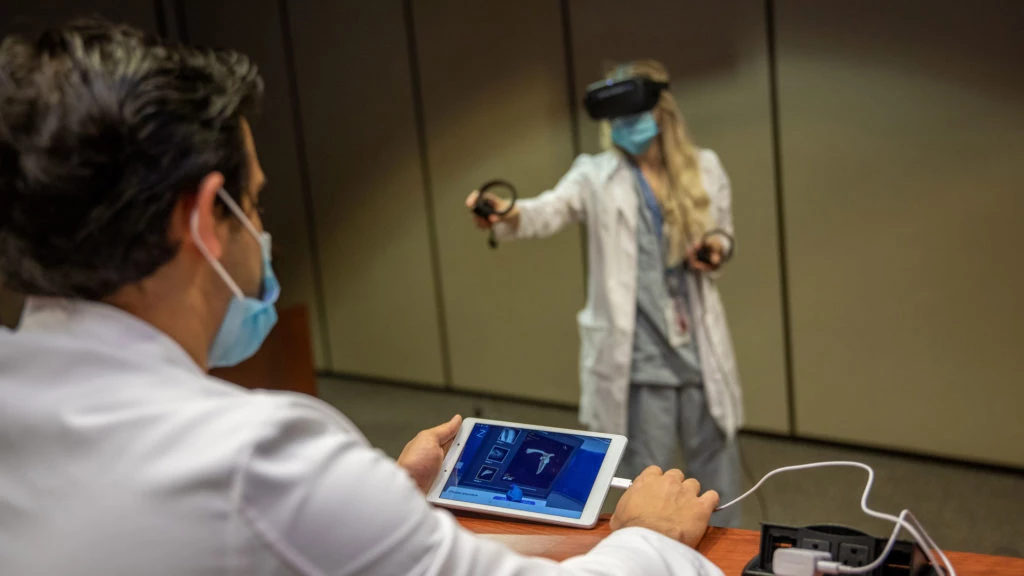
Virtual reality surgical training has generated a lot of excitement in medical education – but does it actually work? For surgical residents and program directors evaluating new training tools, the central question is whether practicing in VR translates into real-world surgical skill and better outcomes. The evidence to date is very promising: numerous studies, trials, and program experiences have shown that VR training (such as the PrecisionOS platform) can significantly improve surgical performance and knowledge, often matching or even surpassing traditional training methods on key metrics. Below, we answer this question in detail with data and findings from the latest research and experiences.
What Do Studies Show About the Effectiveness of VR Training?
A growing body of scientific research has investigated VR surgical training. The results consistently support VR as an effective training modality:
- Fewer Surgical Errors: A rigorous randomized trial published in JAMA Network Open demonstrated that surgeons trained with PrecisionOS VR made nearly 50% fewer critical errors in performing a procedure compared to those trained traditionally[12]. This is a striking improvement in safety and accuracy, indicating that skills learned in VR carry over to the operating room in a meaningful way.
- Faster Mastery of Skills: The same JAMA-published study found that VR training can cut the learning curve by the equivalent of 50 cases for a complex surgical procedure[13]. In practice, that suggests a resident could reach competency far sooner by supplementing with VR, as if they had done dozens of additional real surgeries. VR trainees were also able to save nearly 1 hour of OR time per case because they were better prepared[13].
- As Effective as Cadaver Training: A 2023 randomized controlled trial at University of Toronto found that learning anatomy through PrecisionOS VR was equally effective as learning with cadavers[18][19]. First-year medical students had identical knowledge gains whether they trained on a cadaver or in VR, but the VR had added benefits of reusability and lower cost. This “non-inferiority” result is important—it shows VR can match gold-standard traditional methods (like cadaver labs) in educational outcomes.
- Better Complex Skills than Traditional Methods: Research published in the Journal of Bone and Joint Surgery (JBJS) in 2020 showed that immersive VR training led to “substantially improved” technical skills acquisition for orthopedic residents practicing a complex procedure, outperforming the traditional training group[31]. In this study focusing on a shoulder surgery skill, the VR-trained group demonstrated superior performance in both technical execution and non-technical decision-making during assessments.
- Validated by Multiple Trials: PrecisionOS and similar VR systems have been tested in multiple independent trials, all pointing to effective skill transfer. In fact, several randomized controlled trials have shown improved trainee performance on real or simulated patients after VR training, compared to control groups[32]. These trials establish construct validity (VR can teach real surgical skills) and transferability (those skills show up in actual OR performance).
- Improved Patient Outcomes (Indirectly): While it’s intuitive that better-trained surgeons lead to better patient outcomes, some studies have begun to directly link VR training to patient benefits. A systematic review covering dozens of studies found VR and similar simulations were associated with improvements in technical skills and even patient outcomes at short-term follow-up[33]. This means not only do surgeons perform tasks better after VR training, but patients may experience fewer complications or faster surgeries as a result.
In summary, the scientific evidence strongly supports that VR surgical training is effective. It doesn’t just make for a flashy demo – it tangibly improves how quickly and how well surgical trainees learn skills.
How Does VR Training Benefit Surgical Trainees in Practice?
Beyond exam scores and error rates, VR training provides practical benefits to trainees in their day-to-day learning and confidence:
- Risk-Free Practice: VR creates a safe sandbox for learning. Trainees can practice intricate procedures or rare complications in a realistic setting with zero risk to patients. They can attempt an operation in VR over and over until they get it right, without fear of causing harm. As Dr. Danny Goel (PrecisionOS CEO and an orthopedic surgeon) emphasizes, this allows surgeons to “deliver better care… with no patient risk,” all while training at significant cost savings[17]. The ability to fail safely in VR means that by the time a resident faces the real situation, they have already learned from their mistakes virtually.
- Boosting Confidence and Readiness: One of the most commonly reported effects of VR practice is increased confidence. When residents have repeated a procedure in VR, they feel more prepared and less anxious when they scrub into the real case. For example, at a West Virginia University orthopedic program, junior residents were given 10 minutes of VR arthroscopy practice per week. Faculty noted that these residents arrived in the OR already understanding the steps, and the residents said VR “built confidence, improved orientation, and provided a mental roadmap” for the surgery[22]. This confidence translates into smoother performance and a greater willingness to take on challenging tasks under supervision.
- Engaging, Active Learning: VR training is interactive and immersive, which tends to be more engaging than passive learning. Instead of just watching a surgery or reading a textbook, the trainee is actively “doing.” This kind of active learning through immersion improves knowledge retention and skill memory. Neuroscience research shows that the brain treats VR experiences almost like real experiences, strengthening neural pathways associated with those tasks[34]. In other words, practicing in VR can stimulate the same mental and muscle memory as actual surgery, leading to faster and more robust learning.
- Better Decision-Making Skills: Surgical competence isn’t only about manual technique – it’s also about decision-making and adapting to the situation. VR simulations can be programmed with unexpected events or complications, forcing trainees to think on their feet. They learn to make decisions under pressure in the VR scenario. This was reflected in studies where VR-trained surgeons improved not just technical metrics but also non-technical skills like judgment and communication[31]. By the time they face real high-stress scenarios, they’ve essentially seen it before in VR. This situational preparedness is hard to achieve in sporadic real-life cases.
- Feedback and Self-Improvement: In VR, instant feedback is built-in. Trainees get quantitative scores or qualitative guidance right after a simulation – for example, if they placed a screw incorrectly or took too long on a step, the system flags it. This allows residents to immediately adjust and try again, a loop that greatly aids skill improvement. Traditionally, a resident might only get vague feedback (“you need to be faster” or “be more careful with the retractor”) long after a case is over, without a chance to retry the same scenario. VR closes that loop by providing a chance to refine skills in real time. As a result, residents can systematically eliminate errors from their technique in a way that on-the-job training can’t always provide.
Do Surgical Educators and Trainees Believe VR Training Works?
Yes – the user acceptance of VR training in surgery is high, and many educators now consider it a vital tool. Here are some perspectives:
- High Satisfaction Among Surgeons: A 2024 study reported that 84% of orthopedic surgeons and fellows found immersive VR training easy to adopt and valuable for education and mentorship[28]. This high approval rating shows that even experienced surgeons see real value in VR – it’s not just seen as a gimmick for the younger, tech-savvy generation, but as a useful adjunct for teaching and refining skills.
- Rapid Adoption in Residency Programs: Surgical residency and fellowship programs are increasingly incorporating VR. Over 30% of U.S. orthopedic programs have already added VR surgical simulation to their training[25], and the trend is accelerating. Program directors are including VR modules for various rotations (e.g., trauma, arthroscopy, spine) to ensure residents get consistent practice. In many cases, VR training is being mapped to the curriculum so that residents practice relevant cases before assisting in the OR, as this has proven to enhance their performance and reduce the burden on faculty[35][36].
- Increased Engagement: When VR is integrated into a program, residents tend to use it extensively. Programs that set clear expectations (like requiring a certain number of VR sessions per rotation) see trainees logging over 100 hours of VR training per year on the system[26]. This level of engagement indicates that residents find the VR training helpful and are willing to spend their own time on it. It’s a strong vote of confidence when busy surgical residents voluntarily practice extra hours in VR to hone their skills.
- Testimonials – Educator View: Surgical educators who have tried VR report improved teaching dynamics. For instance, faculty at one institution observed that after their residents trained with VR, they could “skip time-consuming explanations” of basics in the OR and focus on higher-level teaching, because the residents already knew what to do[29]. This made teaching more enjoyable and effective. Educators also appreciate the objective performance data VR provides; they can identify which residents need help and in what areas, rather than guessing. As one program director put it, VR “standardizes exposure… and provides objective data that lectures and cadavers can’t”[37], highlighting that it brings all trainees to a more even and excellent level.
- Testimonials – Trainee View: Residents often comment on how realistic the VR scenarios feel and how much more prepared they feel after. They value the freedom to practice without feeling embarrassed or fearful of harming a patient. In one case study, residents noted that VR gave them a clear mental plan and comfort with the equipment before entering the OR, reducing their stress levels for the real surgery[22]. This stress reduction and familiarity can enhance learning – when not overwhelmed by nerves, trainees can perform closer to their true ability, reinforcing their training.
Is VR Training Cost-Effective and Sustainable for Programs?
Effectiveness isn’t just about skill gains – for a training modality to truly be effective, practical factors like cost and ease of implementation matter. VR surgical training scores well on these fronts, which contributes to its overall effectiveness in real-world adoption:
- Cost Savings: VR training can dramatically lower the cost per training hour compared to traditional methods. For example, one study calculated that immersive VR was 34 times more cost-effective than traditional surgical training (when factoring costs of cadaver labs, faculty time, OR expenses, etc.)[16]. Programs save on expensive cadaver procurement, OR time used for teaching, travel to workshops, and wear-and-tear on physical simulators. A VR system requires an upfront investment, but after that, practice is unlimited at very low marginal cost. This affordability allows residents to practice more without budget constraints, increasing the overall training they receive.
- Minimal Infrastructure Required: Modern VR surgical platforms like PrecisionOS are designed to be plug-and-play. They typically need just a VR headset and a laptop or even no PC at all (for standalone headsets). There’s no need for a dedicated simulation lab with large equipment, no special facilities, and often no on-site IT support beyond a standard Wi-Fi connection[38]. This means any program, even those not attached to huge academic centers, can deploy VR relatively easily. The ease of setup (just put on a headset) encourages frequent use.
- Asynchronous Training – No Scheduling Burden: VR training is highly flexible. Residents can use it during downtime or at home, so it doesn’t compete with their packed hospital schedules. This flexibility is crucial in surgical education where time is at a premium. As one guide noted, “Residents train when they have time—between cases, on lighter rotations, or at home. This flexible access… ensures learning doesn’t stop when schedules get tight”[15]. Essentially, VR adds training hours to a curriculum without extending the formal work hours of residents or faculty. Over the course of a residency, this can substantially increase total practice time, contributing to better skill mastery.
- Scalable and Standardized: Because VR modules are software-based, they can be scaled to many users easily. Every resident can perform the same core cases in VR, ensuring standardized exposure to critical procedures[37]. Traditional training often varies widely – some residents might get lucky to scrub into a rare case, while others never see it. VR can fill these gaps by guaranteeing each trainee gets experience in all the key scenarios (including those that are rare in real life). This scalability is part of what makes VR training outcomes reliable and effective across an entire program, not just for individual motivated learners.
- Continuously Improving Content: The effectiveness of VR training also grows as the technology and content improve. PrecisionOS, for instance, regularly updates its software with new procedures, better graphics, and refined physics based on user feedback and research. This means a residency program’s VR curriculum can stay at the cutting edge of surgical practice without significant additional cost. The platform can also adapt to new techniques or devices faster than a traditional curriculum could. This agility helps keep training effective and relevant, especially in fields like orthopedic or robotic surgery where techniques evolve.
Bottom Line: Does VR Training Work?
Yes. VR surgical training has proven to be an effective educational tool, complementing and enhancing traditional training. Residents who train in VR perform better on objective metrics (like error rates, speed, and technique) and report greater confidence and preparedness. Importantly, studies show that these improvements are not just theoretical – they manifest as real improvements in the operating room, benefiting both the surgeon and the patients.
VR is not a magic shortcut to create expert surgeons overnight, nor is it a replacement for real surgical experience. Instead, it is a powerful amplifier of learning: it allows surgeons to gain more practice (in a safe environment), receive better feedback, and proceed to real surgery with a higher baseline of skill. As a result, valuable OR time is used more efficiently for refining advanced skills rather than teaching basics. Considering the demands of modern surgical training – limited hours, higher complexity, and the need for demonstrated competency – VR has arrived as a timely solution.
For surgical residents and program directors asking “Is VR surgical training effective?”, the answer is that VR training is not only effective, it is quickly becoming essential. It offers a level of preparation and measurable improvement that is difficult to achieve otherwise, and it does so in a cost-effective, scalable manner. In the words of one educator, adopting VR is about “better preparing residents with tools that scale, personalize, and support mastery in a modern surgical curriculum.”[30] With solid evidence in hand and growing real-world adoption, virtual reality has earned its place as a critical component of surgical education for the current and next generation of surgeons.
Research
Effect of Immersive Virtual Reality Training on Surgical Performance – JAMA Network Open
https://jamanetwork.com/journals/jamanetworkopen/fullarticle/2787541
Systematic Review of Virtual Reality Training in Surgery – PubMed
https://pubmed.ncbi.nlm.nih.gov/32947275/
Virtual Reality Versus Cadaveric Anatomy Teaching – PubMed
https://pubmed.ncbi.nlm.nih.gov/37143373/
Simulation-Based Training and Surgical Outcomes – NCBI
https://www.ncbi.nlm.nih.gov/pmc/articles/PMC7937914/