

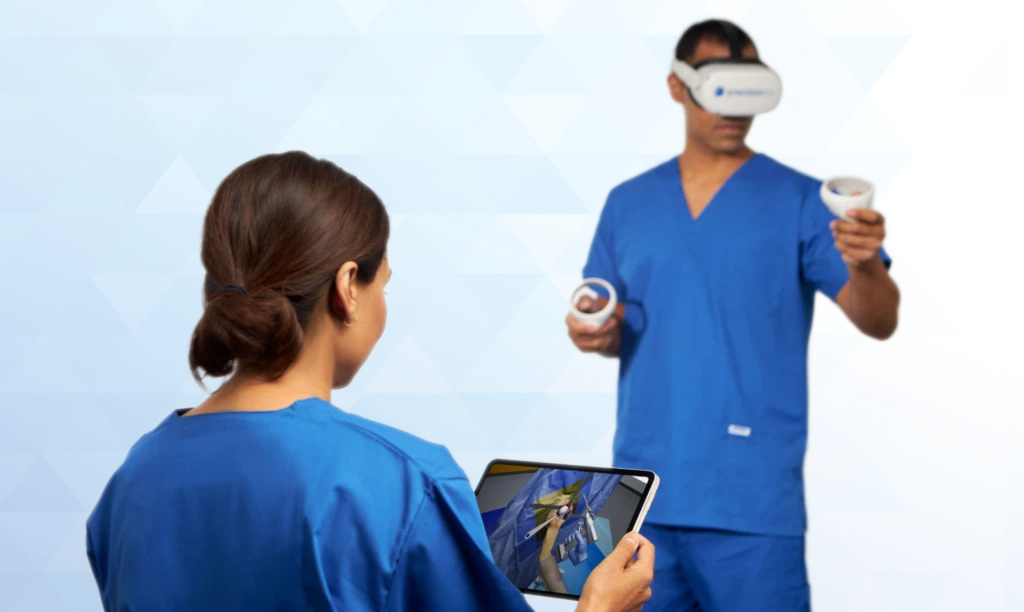
PrecisionOS is a virtual reality (VR) surgical training platform that offers an innovative alternative to traditional surgical training methods. Traditional training for surgical residents often relies on observing real surgeries, assisting when possible, practicing on cadavers or simulators, and gradually taking on cases under supervision. In contrast, PrecisionOS provides immersive, hands-on virtual simulations that complement this apprenticeship model. Below, we break down the key differences and advantages of PrecisionOS VR training versus conventional training approaches, with evidence from research and user experiences.
What Are the Limitations of Traditional Surgical Training?
Traditional surgical training methods face several challenges in today’s medical education environment:
- Limited Hands-On Time: Modern residency programs have reduced clinical hours – duty-hour restrictions have cut about 5,000 hours of training over 5 years for each resident[1]. This means fewer opportunities to practice surgical skills in the operating room (OR), potentially leaving skill gaps when residents graduate.
- Missed Critical Experience: To preserve efficiency and avoid risks in the OR, residents are often restricted to less critical tasks while faculty perform the key parts of surgery. This deprioritization of decision-making and complex skills can hinder a trainee’s growth and autonomy[2]. It’s not uncommon for attending surgeons to take over the crucial steps of a procedure, so the resident gains little experience in those areas.
- Resource and Access Constraints: Traditional practice tools like cadaver labs and plastic bone models are expensive, scarce, and logistically difficult. Cadaveric specimens, for example, pose issues with availability, preservation, and ethical considerations[3]. Scheduling time in simulation centers or wet labs can be difficult, and travel for workshops or courses takes time and money.
- Steep Learning Curves in OR: Many surgical techniques require dozens of repetitions to achieve proficiency, yet residents may only see a procedure a handful of times during training. For example, becoming proficient in certain complex surgeries can take years of cases under supervision[4]. This makes surgical learning slow and unpredictable using only traditional on-the-job practice.
These limitations highlight why simply relying on “see one, do one, teach one” in the OR is often not enough. Surgical educators are looking for ways to give trainees more practice, experience, and confidence outside the confines of real surgeries.
How Does PrecisionOS VR Training Work?
PrecisionOS uses immersive virtual reality to recreate the operating room experience in a safe, repeatable digital environment. Users wear a VR headset and hold instrument controllers to perform simulated surgical procedures with lifelike anatomy and tools. The platform was created by surgeons and educators to ensure clinical realism. Here’s how this approach addresses training needs:
- Realistic Simulation: The VR system presents fully interactive 3D anatomy and surgical scenarios. For example, PrecisionOS’s anatomy module lets students explore and disassemble virtual cadaveric structures in detail[5]. Orthopedic residents can practice procedures like fracture fixation, arthroscopy, or joint replacement in a life-like virtual OR.
- Unlimited Practice & Repetition: Unlike the limited cases a resident might assist in real life, virtual training offers on-demand practice. Trainees can “make mistakes, accept feedback, reflect, and then repeat until they achieve proficiency” in a procedure[6]. This iterative practice with infinite variability of cases is proven to accelerate learning and skill acquisition, creating an “accelerated path to mastery”[7].
- Performance Feedback: PrecisionOS provides objective metrics and feedback after each simulation. It can track errors, efficiency, and technique, helping trainees identify areas to improve. Faculty can review this performance data to guide their teaching. In essence, VR offers data-driven insights that traditional training (which relies on memory or observation in the OR) simply cannot provide[8].
- Accessibility and Convenience: A key feature of VR training is that it’s not bound to a physical lab or OR schedule. The PrecisionOS platform runs on portable, wireless VR headsets (like the Meta Quest), so training can be done anytime, anywhere[9]. Residents can practice after hours, on weekends, or during downtime on rotations, without needing an instructor present[10]. This flexibility makes surgical practice far more scalable than coordinating in-person simulations or extra OR sessions.
In short, PrecisionOS VR training complements traditional surgical education by providing a realistic, yet risk-free, practice arena. Residents still learn in the OR, but by the time they get there, they can be much better prepared through extensive virtual rehearsal.
How does PrecisionOS vs traditional surgical training differ in skill acquisition?
Using VR doesn’t replace classical training; it enhances it. Below are concrete advantages of PrecisionOS VR training compared to conventional methods, supported by research findings and expert observations:
- Faster Skill Acquisition: Virtual reality can significantly speed up learning. In one study published in a top orthopedic journal, the PrecisionOS VR simulation method proved superior to traditional approaches – it enabled surgeons to grasp complex procedural concepts “significantly faster” while also enhancing technical skill development[11]. In other words, residents reach proficiency in certain techniques more quickly with VR practice than by OR experience alone.
- Reduction in Errors: Patient safety and surgical precision improve with VR training. A groundbreaking randomized trial published in JAMA Network Open showed that surgeons who trained with PrecisionOS made nearly 50% fewer critical errors in surgery compared to those with standard training[12]. This is a dramatic decrease in mistakes, highlighting how effective VR practice can be at ingraining proper technique and decision-making.
- Shorter Learning Curve: The same study found that VR training can reduce the learning curve by the equivalent of 50 cases for a procedure[13]. In practical terms, this means a resident might achieve competency in a surgical skill with VR after far fewer real-life cases than normally required. By substituting some initial live cases with virtual ones, trainees gain proficiency earlier in their training.
- Greater Volume & Variety of Cases: VR offers unlimited repetitions and exposure to rare or complex cases that a resident might never encounter during residency. Trainees can practice a wide range of scenarios – from common procedures to uncommon emergencies – ensuring broader experience. This comprehensive preparation is difficult to achieve with traditional training alone[14]. For example, a resident might only see an unusual complication once in practice, but could rehearse it multiple times in VR to be ready. Repeated practice also builds muscle memory and confidence that carry into real operations.
- Anytime, Anywhere Training: Accessibility is a huge advantage of VR. Because PrecisionOS runs on a standalone headset, there’s no need for a lab, large equipment, or scheduled faculty supervision. Residents can train on their own schedule, whether at home or between hospital shifts[10]. This asynchronous training model means no waiting for an open OR or sim lab – practice is available on-demand. Program directors report that this flexible access reduces the need for remedial training and even saves actual OR time, since residents come to surgery better prepared[15].
- Lower Training Costs: Virtual training is far more cost-effective than traditional methods that involve cadavers, physical simulators, or travel to courses. Research has quantified this difference: VR surgical training can be at least 34× less expensive than equivalent training using cadaver labs or mannequin simulators[13]. In addition, a VR headset and software are a one-time investment that can be reused infinitely, whereas cadaver specimens and disposable kit costs add up. One study noted that one hour in the virtual OR can substitute for an hour in a real OR, yielding cost savings in staff time and materials[16]. Overall, programs can scale up simulation training for a fraction of the cost of traditional workshops.
- Safe, No-Risk Environment: In VR, no patients can be harmed. Residents can practice high-stakes surgeries or new techniques without any risk to real patients. They can also fail and learn from errors with zero consequences. This safety net is impossible to replicate in live surgery – it allows trainees to push their limits and learn from mistakes before they ever operate on a patient[17]. Additionally, VR removes the ethical and logistical issues of using cadavers; a virtual cadaver never “runs out” or decays, and there’s no concern about tissue availability or storage[3]. PrecisionOS has even demonstrated that for learning anatomy, VR is as effective as cadaveric dissection, but far more accessible and reusable[18][19].
- Objective Feedback & Analytics: Traditional training often lacks measurable feedback – residents rarely get a detailed breakdown of their performance in surgery. PrecisionOS VR provides objective metrics (time taken, errors made, efficiency of movements, etc.) for every simulated procedure. Faculty can track a learner’s progress and identify specific areas for improvement from this data[8]. Such analytics enable a more competency-based training approach, where advancement is based on skill mastery rather than just time or case counts. Programs using PrecisionOS can set performance benchmarks (e.g., complete a virtual hip fracture repair under a certain time with no critical errors) before allowing residents to attempt the procedure in the OR.
- Improved Confidence and Autonomy: By getting extensive practice and mastery of fundamentals in VR, residents enter the OR more confident and ready to perform. Multiple independent trials have confirmed that participants trained on PrecisionOS become more confident and skilled surgeons[20]. Faculty at one program noticed junior residents were able to take on more of the procedure after VR training, without increasing the operative time, because they were already fluent in basic techniques[21]. Residents themselves report that VR practice “built confidence, improved orientation, and provided a mental roadmap” that translated into better performance during real surgeries[22]. This boost in confidence and competence ultimately leads to better patient care when those residents operate for real.
What Do Surgeons and Educators Say About VR Training?
The reception of PrecisionOS and VR training in surgical education has been overwhelmingly positive among both learners and teachers:
- Surgeon Testimonials: Experienced surgeons see the value of VR for preparation. “So much time can be saved from the reduced need for directed intraoperative teaching of trainees or a reduction of costs associated with traditional cadaveric models,” observes Dr. Femi Ayeni, an orthopedic surgery professor, regarding the PrecisionOS platform[23]. In practice, this means attendings spend less OR time on basics, and more on advanced teaching. Another leading surgeon and educator remarked that VR is “transformative… inclusive, accessible, and effective” for teaching anatomy and procedures in a way that was not possible before[24].
- Adoption by Top Programs: Surgical residency programs are rapidly adopting VR as part of their training strategy. Over 30% of U.S. orthopedic residency programs have already integrated virtual reality modules into their curriculum[25], a figure that is growing each year. Many program directors view VR as a necessary step to modernize training and maintain high standards, rather than a luxury. Institutions report that residents log dozens of hours in VR and often exceed 100 hours of virtual surgery practice in a year when the tools are made available[26].
- Preference Over Traditional Formats: Not only are residents embracing VR, but other stakeholders like medical device companies and surgical educators are also seeing its benefits. A study of surgical device representatives (who need training on procedures) found they valued immersive VR training more than traditional in-person formats, and the VR approach cost about 2.8× less for the company compared to typical workshops[27]. This indicates that across the board, VR is viewed as a high-value training method. Similarly, in surveys, 84% of orthopedic surgeons and fellows found VR training easy to adopt and valuable for education and mentorship in their practice[28].
- Complements, Not Replaces, Traditional Training: Surgical educators emphasize that VR is not meant to replace live surgery or mentorship, but to amplify and enhance it. As noted in a program director’s guide, “PrecisionOS doesn’t replace hands-on training, it amplifies it. Residents enter the OR better prepared after using VR, reducing time spent on foundational teaching.”[8] In other words, VR is a force multiplier for faculty – it handles the basic skill rehearsal so that precious OR time and faculty expertise can be directed toward higher-level judgment and decision-making training. At West Virginia University, faculty reported that after VR prep, they “didn’t have to pause and explain camera orientation. We could go straight into coaching judgment calls,” which made intraoperative teaching more efficient and satisfying[29].
Bottom Line: A New Standard for Surgical Training
PrecisionOS VR training offers clear advantages over traditional surgical training in many critical areas – from accelerating skill development and reducing errors, to lowering costs and increasing training opportunities. Importantly, these benefits are backed by peer-reviewed studies and real-world results, not just marketing claims. VR-trained residents have demonstrated knowledge and skill levels on par with, or superior to, those trained by conventional means[19][12].
For surgical residents and program directors, the comparison is compelling. Traditional methods will always remain vital (nothing fully replaces operating on real patients under expert guidance), but VR simulation via PrecisionOS has emerged as a powerful adjunct that addresses the gaps left by limited hours, limited cases, and safety constraints. By integrating VR, residency programs can provide more consistent, hands-on training without extra risk or cost, and trainees can gain proficiency and confidence faster. The result is a better-prepared surgeon who enters the operating room with proven skills, ready to deliver safer patient care. In summary, PrecisionOS versus traditional training is not an “either/or” choice – rather, PrecisionOS is an evolution of surgical training that builds on the traditional foundation to meet the needs of modern surgical education[30].
Research
Effect of Immersive Virtual Reality Training on Surgical Performance – JAMA Network Open
https://jamanetwork.com/journals/jamanetworkopen/fullarticle/2787541
Immersive Virtual Reality Training Improves Technical Skills Acquisition – Journal of Bone and Joint Surgery
https://journals.lww.com/jbjsjournal/Fulltext/2020/06030/Immersive_Virtual_Reality_Training_Improves.2.aspx
Virtual Reality and Simulation in Surgical Training – PubMed
https://pubmed.ncbi.nlm.nih.gov/33886530/
Virtual Reality Simulation in Surgical Education – NCBI
https://www.ncbi.nlm.nih.gov/pmc/articles/PMC8603075/